I met Isah* when he was two and a half. Isah was severely malnourished and had never walked, something we would typically expect an 18-month-old to do. That was concerning enough, but Sadiya*, his mother, told us that he had also stopped crawling.
Isah was regressing. This is a clear red flag.
Isah had just arrived at the malnutrition unit at Unguwa Uku hospital [in Kano state], where I work as a pediatric physiotherapist.
I’ve worked in pediatrics for years, but never in a specialist malnutrition environment until now. When I first started, I was shocked. I’m from Kano myself, and while I knew that malnutrition exists in rural areas of our state, I didn’t realize how widespread it is or the dire consequences it’s having.
THE IMPACTS OF MALNUTRITION
Severe acute malnutrition affects the body in different ways. It stunts growth, causes muscle wasting and, in some cases, restricts joint mobility and causes painful skin lesions. Without the energy to move or play, children become physically weaker, and don’t get the stimulation they need to learn.
In some cases, malnourished children stop progressing through developmental milestones or start to regress. Without the right care, these developmental delays can have lasting physical and cognitive impacts, leaving children with long-term disabilities.
ISAH’S JOURNEY
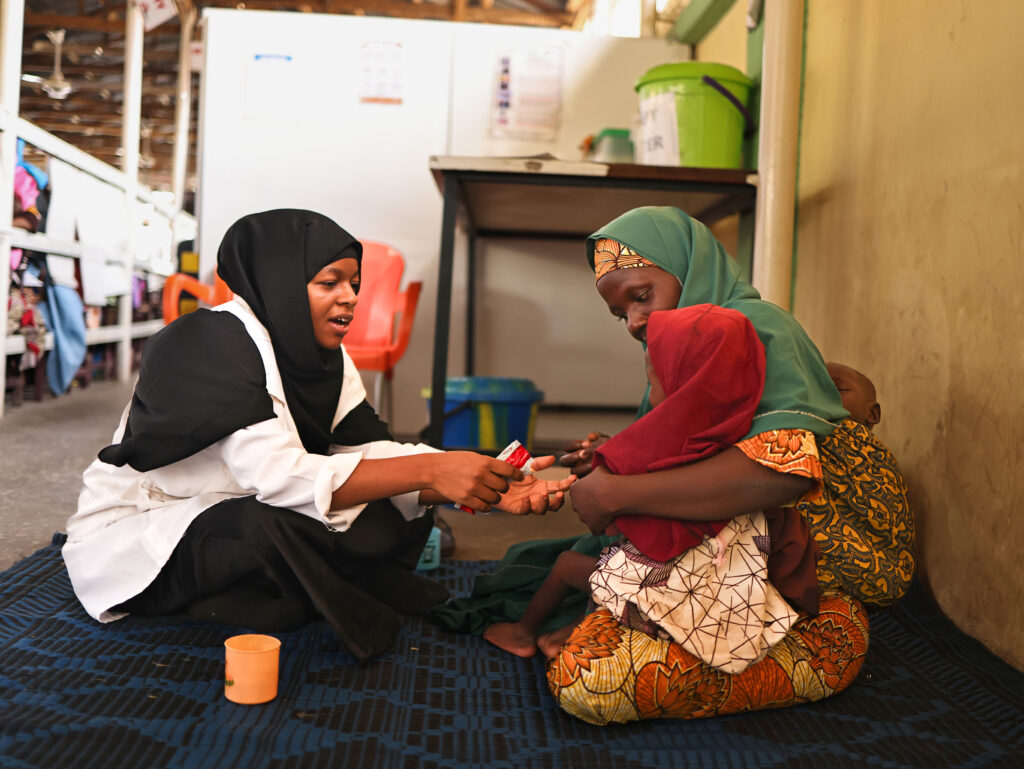
Children learn best when they are calm. For the first visit, we didn’t do any planned exercises, we just played. We did some singing. Having a malnourished child is really hard for parents, so I made sure to show Sadiya how she could join in – I wanted them both to feel relaxed.
In our second session, Isah clapped when he saw me! This was a good sign, so we started work on our next target: revitalizing his crawling abilities. Luckily, Isah really liked the therapeutic milk we have on the unit, which is specially formulated for children with severe acute malnutrition. We used it to encourage different types of movement, building up his muscles. Quite rapidly, Isah was crawling towards the milk.
Sadiya and I were both really pleased. However, Isah had crawled before, so this wasn’t a new skill. He had never walked, so that was going to be more of a challenge.
We worked on giving Isah the strength and confidence to pull himself up to standing. Having achieved that, he started “cruising”, holding on to the furniture to get around on his feet. But we needed to get him walking unaided.
I still remember the day he took his first steps. We were working on his pelvic rotation. I had two two little tables set up at a 45-degree angle, so that if Isah was holding on to one, he would have to turn to grab the other.
We repeated the exercise, gradually increasing the distance between the tables. Then suddenly Isah stood straight, not holding on to anything.
I asked Sadiya to come round in front of him. And Isah took one step, then another, and then he fell.
I looked to Sadiya, ready to reassure her. We were on soft mats so I knew Isah wasn’t hurt, but I thought his mom might panic seeing him fall like that. But Sadiya’s face was filled with excitement. She wasn’t worried about the fall. He had walked!
From there, Isah continued to make great progress. At his final assessment, he could walk over 7 metres without falling.
“Mothers are essential to their children’s recovery.”
WORKING WITH MOTHERS IS CRITICAL
On the day he was due to be discharged from the hospital, Sadiya volunteered to speak to the other moms about her experience. The last thing she told them really captivated me. She said “I brought a malnourished child to this facility to cure his malnutrition. But in the end, I am going home with a nourished child and a straight [upright] child.”
I had tears in my eyes. We often hear from families that when a child stops walking for months, they assume there is a permanent disability and nothing can be done. It’s devastating for them, but it also means children don’t get the help they need.
Mothers are essential to their children’s recovery. I might only do five sessions with a child, but a mother is with their child every day. If caregivers are demoralized, anxious or hopeless, we try to be their hope. We try to get alongside the parents, support them, give them the tools, so we can say, “Actually, there is a way. This child has a chance. If you motivate them and play with them and stimulate them, they will respond and achieve their milestones.”
*Names changed
RISING MALNUTRITION MET WITH AID FUNDING CUTS
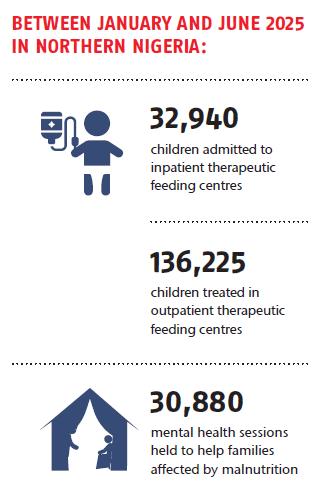
Multiple overlapping factors are driving this worsening crisis, including insecurity and violence, the spiraling cost of living and a lack of other basic health services. Now, massive budget cuts, particularly from the United States, the United Kingdom and other European countries, are having real consequences for malnourished children. In July 2025, for example, the World Food Programme was forced to suspend all emergency food and nutrition aid for 1.3 million people in northeast Nigeria due to “critical funding”.
While MSF is not directly affected, we cannot replace suspended programs. Our teams are working at their limits, often in areas where we are the only international medical humanitarian organization present. With the current trend, we may soon be looking at an even more catastrophic situation for children and their families in northern Nigeria.