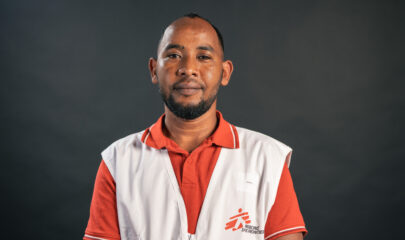
“I ran for my safety once I heard the shooting,” says Albert*. “I am separated from my family, my wife and my children. I do not know where they are. I do not know if they are still alive or not.”
Albert was working as a nurse for Doctors Without Borders/Médecins Sans Frontières (MSF) in Lankien, Jonglei state when South Sudan’s government forces attacked the city on Feb. 3. Large parts of the MSF hospital were damaged during the bombardment and later burned down. Medicines, vaccines and blood supplies were destroyed or looted.
As the violence intensified in the days that followed, healthcare workers fled alongside the residents. Albert was among them.
On the day of the airstrike, Albert had already followed instructions to evacuate the city amid rising tensions. As the bombardment intensified, his house was burned and his belongings looted. He fled into the forest carrying only a small bag containing fortified peanut paste, biscuits and his documents.
Albert walked for five days through remote areas, avoiding armed men, before reaching safety. He is now temporarily staying with a friend in Juba, the capital. His experience reflects that of many South Sudanese and other locally recruited healthcare workers living and working in conflict zones around the world.
VIOLATIONS OF INTERNATIONAL HUMANITARIAN LAW
Intentional attacks on hospitals and humanitarian workers are prohibited under International Humanitarian Law and are considered war crimes. However, in recent years, there have been many such attacks in global conflict zones by organized armed groups and government forces alike – in Haiti, Palestine, South Sudan, Sudan, Ukraine and beyond.
When healthcare is attacked, hospitals close. Humanitarian organizations withdraw. And communities – already affected by violence – become deprived of essential care. Beyond the destruction of medical infrastructure, these attacks deeply affect the very people providing vital assistance.
Medical care, humanitarian workers and civilians must never be a target. People deserve safety and access to healthcare: free from airstrikes on hospitals, shots fired on ambulances and fear in places meant to provide lifesaving care.
*Name changed to protect identity.